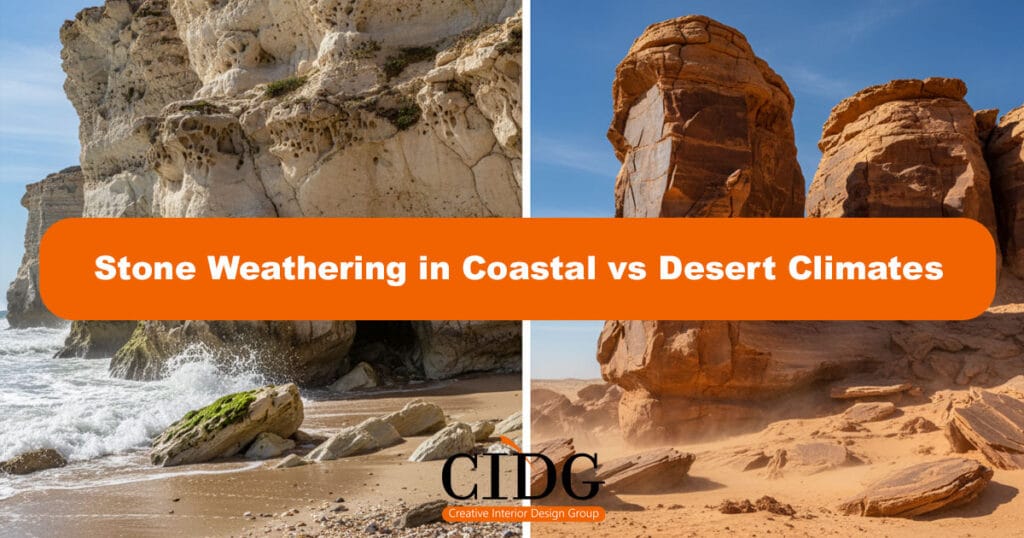
The Science Behind Stone Weathering in Coastal vs Desert Climates
Natural stone is one of the most durable building materials available, but its long-term performance is deeply influenced by climate. Coastal and desert environments expose stone to very different stresses, affecting appearance, durability, and maintenance requirements.
Understanding how stone behaves in each climate allows architects, developers, and homeowners to select materials that age gracefully and perform reliably over decades.
What Is Stone Weathering?
Stone weathering refers to the gradual physical and chemical changes that occur when stone is exposed to environmental conditions. These changes may include surface erosion, color shifts, micro-cracking, or material loss.
Weathering does not indicate failure—when understood and managed correctly, it becomes part of the stone’s natural aging process.
Key Factors That Influence Stone Weathering
- Moisture exposure and absorption
- Temperature fluctuations
- Salt crystallization
- UV radiation
- Wind abrasion and airborne particles
The intensity and combination of these factors vary significantly between coastal and desert climates.
Stone Weathering in Coastal Climates
Coastal environments are characterized by high humidity, salt-laden air, wind, and frequent moisture exposure. These conditions accelerate specific weathering mechanisms.
Salt Crystallization and Moisture Absorption
Salt carried by sea air penetrates stone pores. As moisture evaporates, salt crystals form and expand, generating internal pressure that can cause surface flaking or granular loss—especially in porous stones.
Best Stone Choices for Coastal Areas
Low-porosity stones perform best in coastal conditions. Dense materials such as Egyptian granite offer excellent resistance to salt and moisture intrusion.
Premium options like Black Aswan granite, Aswan red granite, and New Halayeb granite are commonly specified for coastal façades, paving, and marine-adjacent projects.
Among limestone options, textured finishes such as Dijon tumbled limestone and Dijon tumbled limestone pavers perform well when properly selected and sealed.
Stone Weathering in Desert Climates
Desert climates present a different set of challenges: intense solar radiation, extreme heat, large temperature swings between day and night, and abrasive sand-laden winds.
Thermal Expansion and UV Exposure
In desert conditions, stone expands during the day and contracts rapidly at night. Over time, repeated thermal movement can lead to micro-cracking if the stone lacks sufficient density or is improperly installed.
UV exposure can also cause subtle color fading, particularly in lighter stones.
Best Stone Choices for Desert Environments
Dense stones with stable mineral structures perform best. Granite Egypt products are ideal due to their resistance to thermal shock.
High-quality marble varieties such as Egyptian marble, including Galala marble, Galala beige marble, Triesta marble, Sunny marble, and Silvia marble are frequently used in desert architecture due to their heat tolerance and visual stability.
The Role of Porosity in Climate Performance
Porosity determines how much moisture a stone absorbs and how it reacts to environmental stress. Low-porosity stones resist salt intrusion and thermal damage, while higher-porosity stones require careful detailing and maintenance.
This is why professional stone specification always considers climate conditions alongside aesthetics.
Finishes and Their Impact on Weathering
Surface finishes influence how stone interacts with its environment.
- Textured finishes like split face conceal minor weathering and enhance visual depth.
- Highly polished finishes reflect heat but may show wear more clearly over time.
- Honed finishes offer a balance between durability and appearance.
Installation and Detailing: A Critical Factor
Even the best stone can fail if installed incorrectly. Proper drainage, expansion joints, mechanical fixing systems, and correct adhesive selection are essential in both climates.
Well-designed detailing allows stone to move naturally and release moisture safely, extending its lifespan.
Why Climate-Specific Stone Selection Matters
Stone that performs exceptionally in a desert environment may not be ideal for a coastal project—and vice versa. Understanding climate science ensures that stone ages with character rather than deteriorating prematurely.
This is why materials sourced through experienced suppliers of marble Egypt and granite are evaluated not only for beauty, but for environmental compatibility.
Frequently Asked Questions (FAQs)
Does stone weather faster in coastal or desert climates?
Both climates are demanding, but for different reasons. Coastal areas accelerate salt-related weathering, while desert climates stress stone through heat and thermal movement.
Is granite suitable for both climates?
Yes. Granite’s low porosity and high density make it one of the most versatile stones for both coastal and desert environments.
Can marble be used outdoors in harsh climates?
Yes, when properly selected, finished, and installed. Dense marble performs well in dry desert climates.
Does sealing prevent stone weathering?
Sealing reduces moisture absorption and staining but does not stop natural weathering entirely.
Why is climate analysis important before stone selection?
Because climate directly affects durability, maintenance needs, and long-term appearance.
📞 Contact CID Egypt for Orders & Inquiries
📞 Mobile: +20 100 164 9770
💬 WhatsApp: https://wa.me/201001649770
✉️ Email: marketing@cidegypt.com
🌐 Contact Form: https://www.cidegypt.com/contact-us/